
If you have been diagnosed with sleep apnoea or another breathing disorder, you may have heard of CPAP, APAP and BiPAP machines as possible forms of positive airway pressure therapy.
Although these devices may look similar, they do not deliver air pressure in exactly the same way.
A BiPAP machine, also known as a bilevel positive airway pressure machine, provides two different pressure levels: a higher pressure when you breathe in and a lower pressure when you breathe out. This makes it different from conventional CPAP therapy and may make breathing more comfortable or provide additional respiratory support for certain patients.
For people researching a BiPAP machine in Malaysia, understanding how the technology works and why a healthcare professional may recommend it is an important first step.
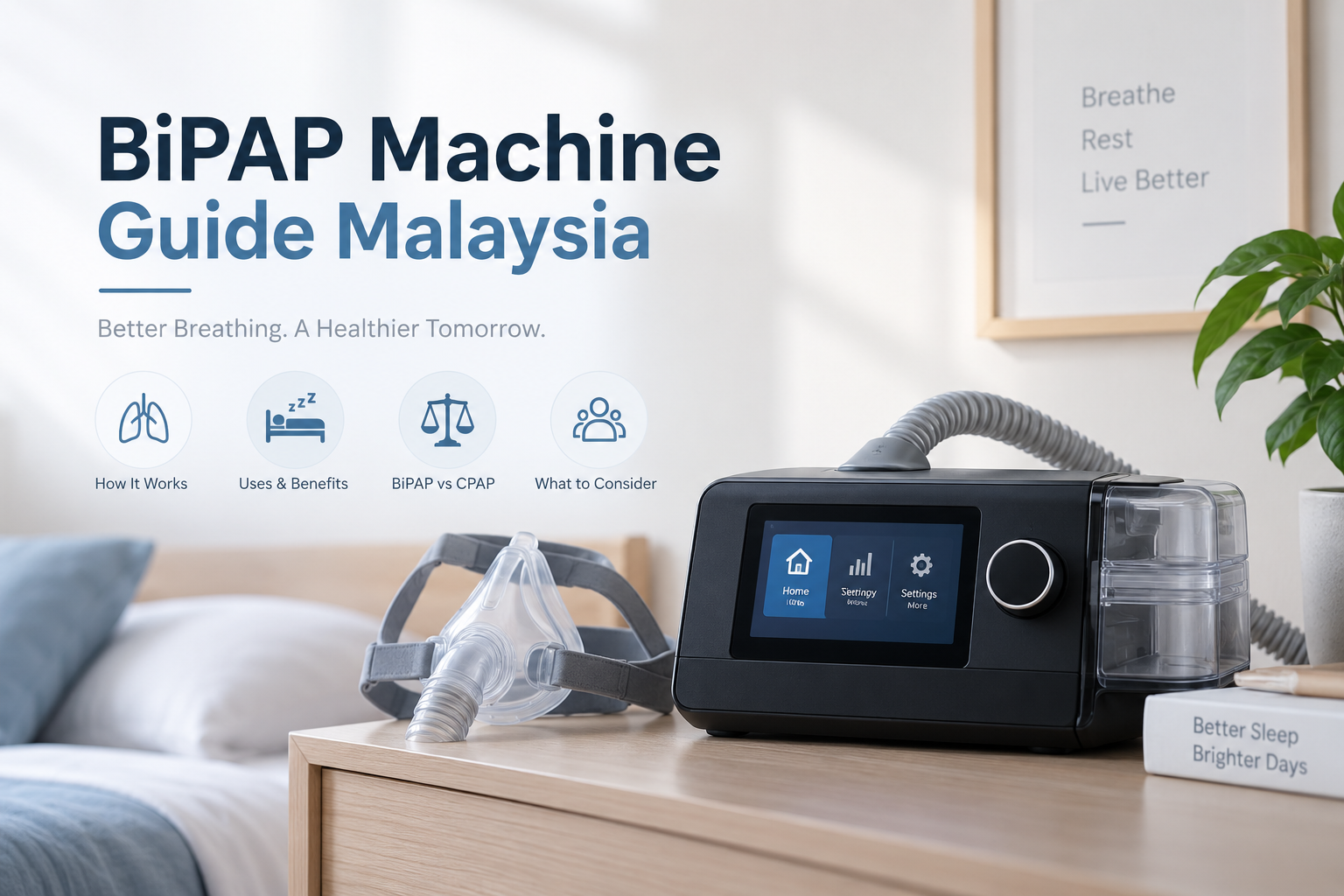
Lorem ipsum dolor sit amet, consectetur adipiscing elit. Ut elit tellus, luctus nec ullamcorper mattis, pulvinar dapibus leo.
A BiPAP machine is a form of non-invasive positive airway pressure therapy.
During treatment, the machine draws in room air and delivers pressurised airflow through tubing connected to a mask. The pressure helps support breathing while the patient sleeps or, depending on the medical condition, during other periods when respiratory assistance is required.
The defining feature of BiPAP therapy is its two pressure levels:
The difference between these two pressures can assist inhalation while making exhalation against the airflow easier.
This is why BiPAP may be appropriate for selected patients who require more sophisticated pressure support than conventional CPAP therapy.
A typical BiPAP system consists of several components:
When you inhale, the device supplies the prescribed IPAP pressure.
When you begin to exhale, it switches to the lower EPAP pressure.
The transition between the two levels is designed to follow the user’s breathing pattern. Certain bilevel devices may also incorporate additional operating modes or backup breathing functions depending on their intended clinical use.
Because pressure requirements vary from patient to patient, BiPAP settings should not simply be copied from another person’s device.
A healthcare professional may determine appropriate settings based on factors such as the patient’s diagnosis, sleep-study findings, breathing pattern and response to therapy.
One of the most common questions about sleep therapy is the difference between BiPAP vs CPAP.
Both belong to the broader category of positive airway pressure therapy, but the way pressure is delivered differs.
| Feature | CPAP | APAP | BiPAP |
|---|---|---|---|
| Pressure delivery | Continuous pressure | Automatically adjusts within a prescribed range | Two pressure levels |
| Inhalation pressure | Same prescribed pressure | Adjusts as required | Higher IPAP |
| Exhalation pressure | Same prescribed pressure | Pressure may vary according to the device | Lower EPAP |
| Common application | Frequently used for obstructive sleep apnoea | Obstructive sleep apnoea with varying pressure requirements | Selected sleep or respiratory conditions requiring bilevel support |
| Clinical setup | Required | Required | Required |
For many people with obstructive sleep apnoea, CPAP is commonly considered before BiPAP.
However, BiPAP may be considered when a person requires higher pressures, experiences difficulty breathing out against continuous pressure or has another condition requiring additional ventilatory support.
Neither system is automatically “better”. The appropriate treatment depends on the individual’s medical needs.
A BiPAP machine is not required by everyone who has sleep apnoea.
Healthcare professionals may consider bilevel therapy in specific circumstances.
Some patients find it uncomfortable to breathe out against continuous positive pressure, particularly when higher therapeutic pressures are required.
Because BiPAP reduces the pressure during exhalation, breathing may feel more natural for selected patients.
However, experiencing discomfort with CPAP does not automatically mean that switching to BiPAP is necessary.
Mask fitting, humidification, pressure adjustments and other therapy factors may first need to be assessed.
Obstructive sleep apnoea occurs when the upper airway repeatedly narrows or becomes blocked during sleep.
Positive airway pressure can help keep the airway open.
While CPAP remains widely used for OSA, a sleep specialist may recommend BiPAP for sleep apnoea when the patient’s pressure or breathing requirements make bilevel therapy more appropriate.
Some patients experience breathing disorders that involve more than physical obstruction of the airway.
Depending on the diagnosis, healthcare professionals may consider specialised bilevel modes or other forms of non-invasive ventilation.
These situations require proper clinical assessment because different conditions may require different types of PAP therapy.
Bilevel positive airway pressure can also be used as non-invasive ventilatory support for certain respiratory conditions when clinically appropriate.
The exact device and treatment mode depend on the underlying condition and should be prescribed or recommended by the treating healthcare team.
No.
Although searches for BiPAP machine Malaysia are frequently associated with sleep apnoea, bilevel devices can have broader respiratory applications.
Certain devices may be designed to provide non-invasive ventilation for patients with respiratory insufficiency or other breathing difficulties.
For example, Malaysia’s Medical Device Register includes bilevel positive airway pressure devices intended for conditions including obstructive sleep apnoea and respiratory insufficiency.
Importantly, not every BiPAP device has the same intended purpose.
The specific indication, operating modes and capabilities of the device should therefore be considered rather than assuming all bilevel machines are interchangeable.
If your healthcare provider recommends BiPAP therapy, choosing the machine involves more than comparing individual device specifications.
Different BiPAP machines may support different operating modes.
The appropriate mode depends on the reason bilevel therapy has been prescribed and the level of respiratory support required.
BiPAP therapy relies on appropriate IPAP and EPAP settings.
These pressures should be configured according to the patient’s clinical requirements rather than adjusted without professional guidance.
Even a suitable machine may be difficult to use consistently if the mask does not fit correctly.
Common interfaces include:
The right choice can depend on facial structure, breathing habits, comfort preferences and potential air leakage.
Pressurised airflow may cause nasal or throat dryness for some users.
A compatible heated humidifier can help improve comfort during therapy when appropriate.
Modern positive airway pressure devices may collect therapy information such as usage duration, leakage and breathing-event data.
These data can help healthcare professionals evaluate how therapy is progressing and determine whether further adjustments may be necessary.
BiPAP is medical equipment intended for ongoing therapy.
Access to proper setup assistance, mask guidance, troubleshooting, maintenance and technical support can therefore be important for long-term use.
BiPAP machines are medical devices, so patients and healthcare providers should pay attention to where respiratory equipment is sourced.
Malaysia’s Medical Device Authority (MDA) provides a public Medical Device Register that can be used to search registered medical devices and licensed establishments.
Before obtaining a machine, consider checking:
These factors are particularly important for equipment that may be used every night as part of long-term respiratory therapy.
It can take time to become accustomed to positive airway pressure therapy.
Some users may initially experience:
Many comfort issues can be related to mask fit, humidification or therapy settings.
Rather than stopping treatment or changing the pressure independently, discuss persistent problems with your healthcare professional or respiratory equipment provider.
You generally cannot determine this based on symptoms alone.
Symptoms such as:
may indicate the need for further evaluation for sleep-disordered breathing, but they do not determine which PAP machine should be used.
A proper assessment may include medical consultation and a sleep study.
The results can help determine whether positive airway pressure therapy is suitable and which type of PAP device best matches the patient’s needs.
GS Med provides sleep apnoea solutions in Malaysia, including CPAP, BiPAP and related sleep therapy equipment for healthcare providers and patients requiring professional respiratory support.
BiPAP refers to bilevel positive airway pressure. It provides a higher pressure while the user inhales and a lower pressure while the user exhales.
BiPAP machines may be used for selected patients with obstructive sleep apnoea and certain other respiratory conditions where bilevel pressure or additional ventilatory support is clinically appropriate.
Not necessarily.
CPAP and BiPAP are designed for different therapy requirements. CPAP is commonly used for obstructive sleep apnoea, while BiPAP may be considered when different inhalation and exhalation pressures are required.
The appropriate device should be determined based on clinical assessment rather than choosing one because it appears more advanced.
Whether a sleep study is required depends on the patient’s condition and clinical circumstances. If sleep apnoea is suspected, proper medical evaluation is important before beginning PAP therapy.
Pressure settings should be determined and adjusted according to professional clinical guidance.
Incorrect settings may reduce treatment effectiveness or create unnecessary discomfort.
BiPAP is a form of non-invasive ventilation, but bilevel devices vary considerably in their intended use and capabilities.
Some provide sleep-related positive airway pressure therapy, while others offer more advanced ventilatory-support functions. A specific BiPAP device should therefore be selected according to the patient’s clinical requirements.
Choosing between CPAP, APAP and BiPAP should begin with understanding the breathing problem that needs to be treated.
A BiPAP machine provides two levels of positive airway pressure, allowing higher pressure during inhalation and lower pressure during exhalation. This makes bilevel therapy useful in selected situations where conventional continuous-pressure therapy may not provide the required comfort or respiratory support.
If you have already undergone a sleep study, received a PAP prescription or need guidance on appropriate respiratory equipment, professional advice can help you understand the available options.
GS Med provides sleep apnoea and respiratory therapy solutions for healthcare professionals and patients across Malaysia, together with product guidance and after-sales support.
Explore GS Med’s sleep apnoea solutions or contact the GS Med team to discuss suitable sleep therapy equipment for your requirements.
This article is provided for general educational purposes and does not replace diagnosis, treatment or advice from a qualified healthcare professional.
If you are looking for a reliable tracheostomy management equipment supplier in Malaysia, GS Med Sdn Bhd is ready to support your clinical and patient care needs with trusted products and professional service.
Contact us today to request product details, pricing, or consultation.
Let us help you provide safe and effective airway management with confidence.